
From Hangzhou 2022 to Aichi-Nagoya 2026
The Four Years That Changed the Way Bhutan Competes
By Victor Gurung
Press Attaché | Team Bhutan
20th Asian Games Aichi-Nagoya 2026
OKAZAKI, Japan | 2 Oct 2026

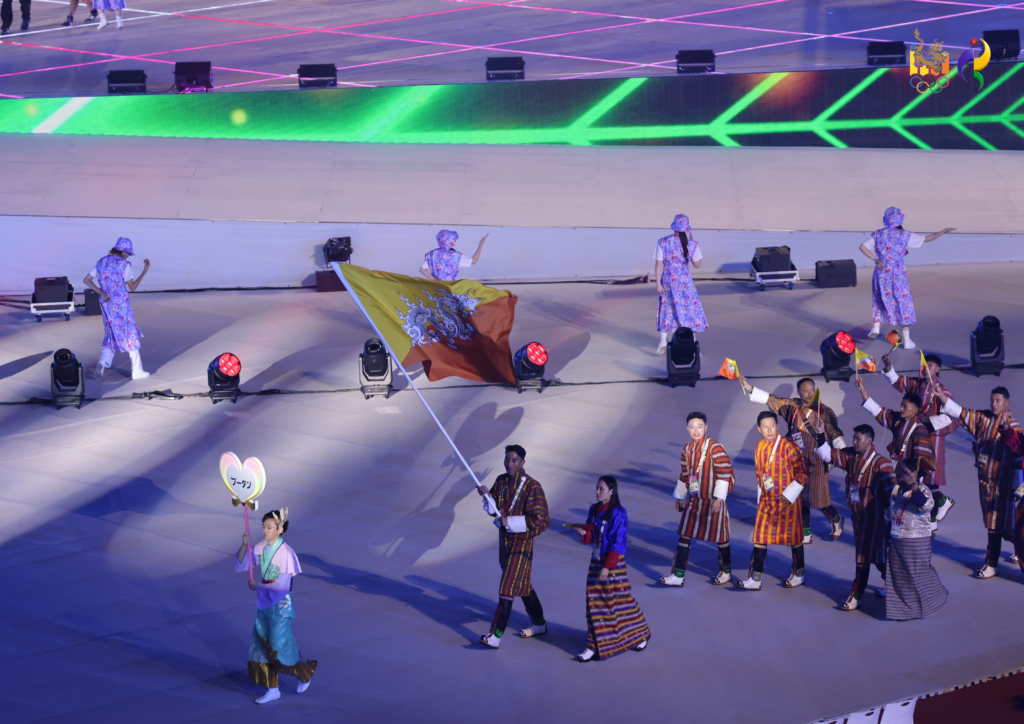
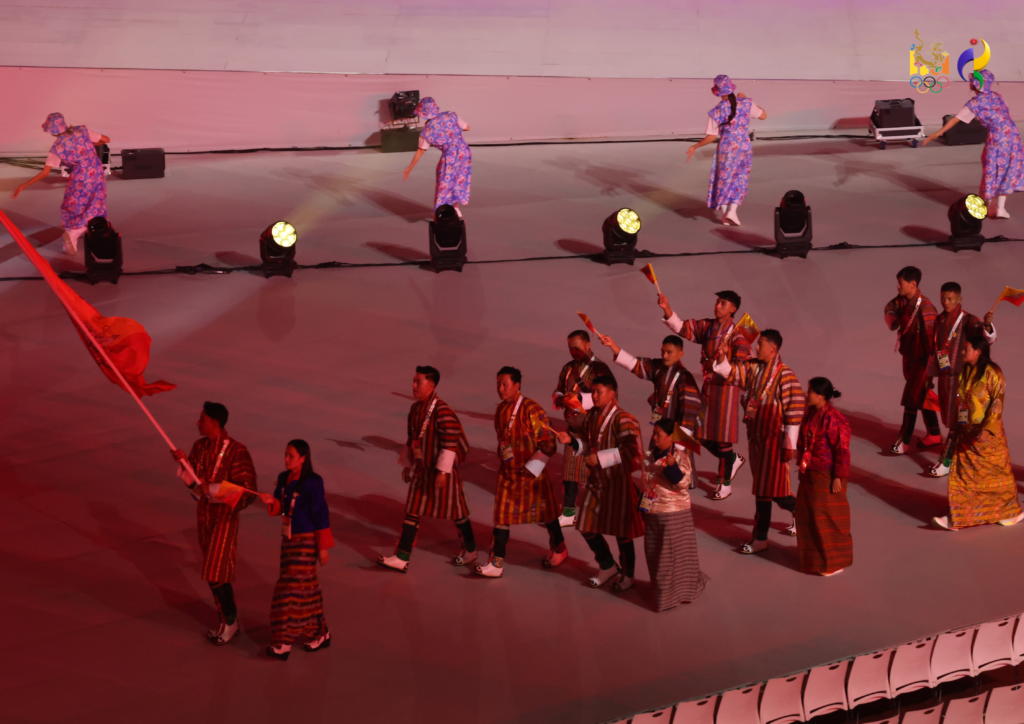
When Team Bhutan walked into the stadium in Nagoya for the opening of the 20th Asian Games, the sight of 13 athletes behind the national flag carried a meaning that went well beyond the number itself. Four years earlier, Bhutan had taken one of its largest ever contingents to the Asian Games, sending 28 athletes across 10 sports to Hangzhou, where badminton, judo, karate and swimming made their Asian Games debuts for Bhutan. The size and diversity of that delegation reflected an important stage in the development of Bhutanese sport, one in which participation, exposure and the opportunity to place more Bhutanese athletes on a major continental platform were central to the journey.
Aichi-Nagoya presents a different picture. Thirteen athletes are competing across four sports, with the team built around archery, athletics, boxing and taekwondo. The composition of the delegation reflects a more focused approach to competition and preparation, with athletes who have been developing through more structured high-performance pathways. The comparison between the two Games therefore cannot be understood simply by looking at the number of athletes or sports represented. The more important comparison lies in the purpose behind the two delegations, the preparation that surrounded them, the level at which athletes have been competing and, perhaps most importantly, what Bhutan has learned about building athletes for the demands of international sport.
That is why Aichi-Nagoya deserves to be viewed alongside Hangzhou rather than separately from it. The performances we are witnessing in Japan did not begin when the athletes entered their venues this September. They are connected to decisions made, opportunities created, competitions entered, coaches appointed, training undertaken and athletes supported during the years between the two Games. Some of those decisions were visible, while much of the work happened away from public attention, in training halls, on running tracks, at archery ranges, in boxing rings and through international competitions where Bhutanese athletes repeatedly tested themselves against stronger and more experienced opposition.
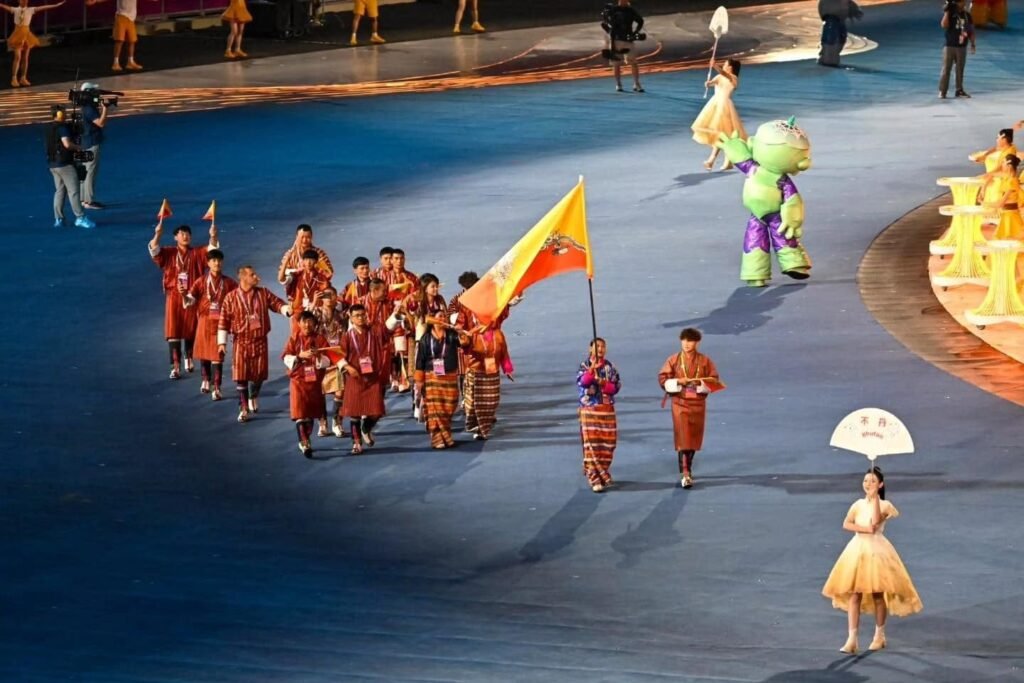
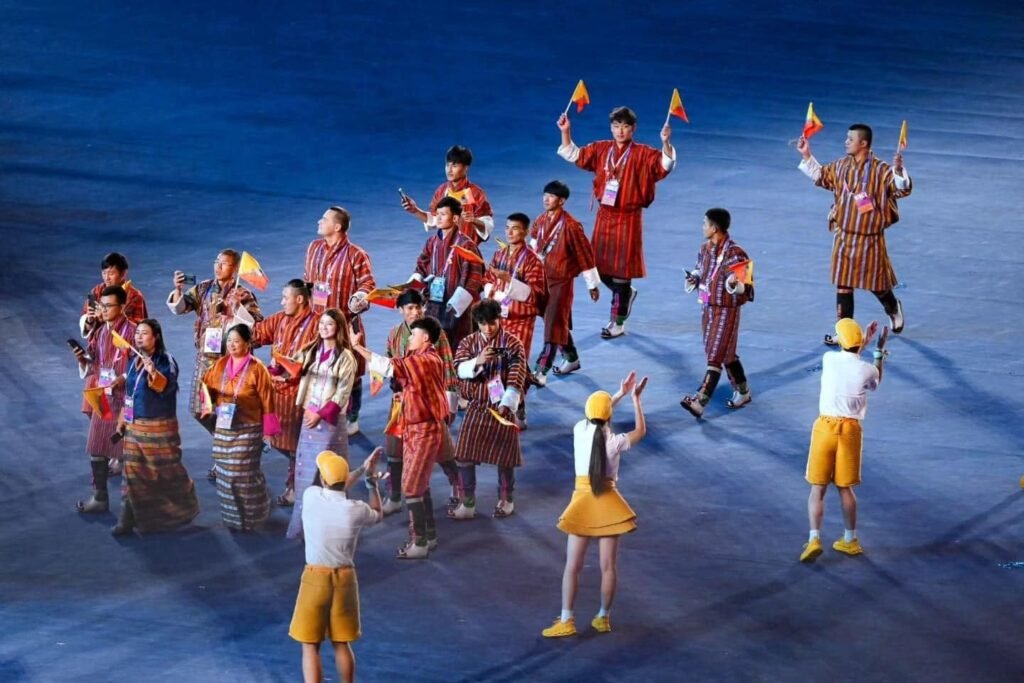
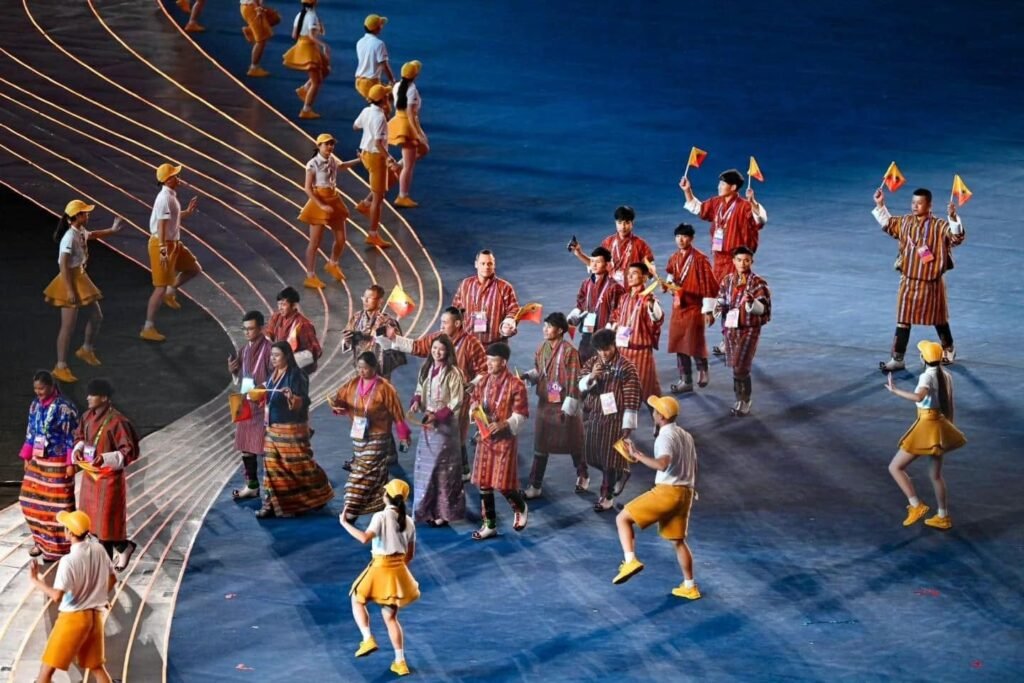
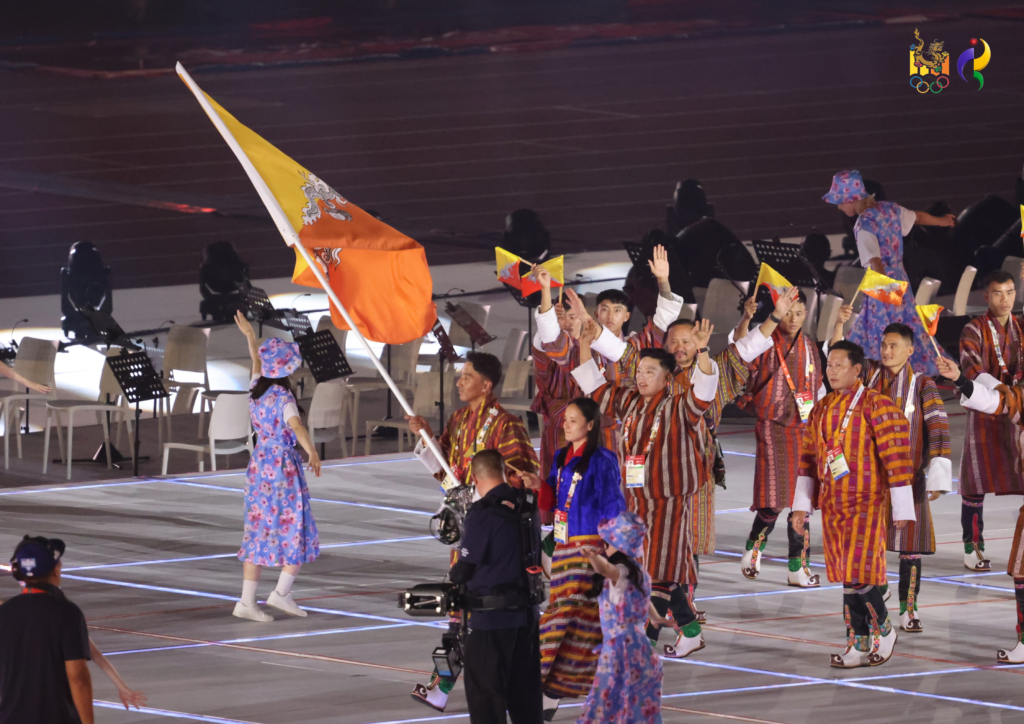
Hangzhou was important because it showed both the ambition and the opportunity in front of Bhutan. Sending 28 athletes across 10 sports created broad representation of Bhutanese sport, and several athletes were given their first experience of the Asian Games in disciplines that had never before represented the country at that level. There was also recognition of the importance of preparing athletes outside Bhutan, with badminton and swimming athletes training in Thailand and four taekwondo athletes receiving specialised training at Kyung-II University in Korea. These were meaningful steps because international competition cannot be understood fully from within domestic competition; athletes have to experience different levels of speed, pressure, tactics, facilities and expectations before they can understand where they stand.
The period after Hangzhou therefore mattered just as much as the Games themselves. A major multi-sport event happens every few years, but an athlete’s development happens every day in between. The four-year Asian Games cycle provides the space in which a young athlete can move from potential to performance, where a coach can refine a technical weakness, where a federation can identify what is needed in its preparation and where institutions can decide whether international exposure should remain occasional or become part of a deliberate high-performance pathway.
That shift in thinking can be seen in the way Bhutan approached Aichi-Nagoya. The 2026 delegation is smaller in number, but it is also more concentrated, with athletes selected from four sports and supported through a more clearly defined high-performance pathway. The Bhutan Elite Athlete Support and Training, or BEAST, program became one of the mechanisms through which the Bhutan Olympic Committee sought to provide selected athletes with structured support, training and competition opportunities leading toward Aichi-Nagoya. Its athlete agreement placed emphasis on sustained training, participation in required camps and competitions, performance reviews and prioritising preparation for the Asian Games.
It would be too simple, however, to say that one program produced the results now being seen in Japan. High-performance sport rarely works that way. An athlete’s progress is shaped by a combination of coaching, federation planning, access to competition, training environment, sports science, financial support, family, discipline and the athlete’s own willingness to continue through the difficult periods when progress is not immediately visible. BEAST is one part of that wider system, and its importance is better understood as part of a broader attempt to create a more consistent pathway for athletes rather than as a single explanation for every result.
The clearest evidence of that development can be found in Bhutanese archery, particularly in the compound men’s team. At the 2018 Asian Games in Jakarta, Bhutan finished 13th in the men’s compound team event. At Hangzhou, the team moved to 10th. In Aichi-Nagoya, Tandin Dorji, Tshetrim Gaytshey and Kezang Norbu took another step forward by reaching the quarterfinals and eventually finishing seventh after losing 235–232 to India. The progression from 13th to 10th to seventh across successive Asian Games is difficult to dismiss as a single good day because it shows movement across competitions and across years.
The same competition offered another indication of how the level of individual performance is changing. Tandin Dorji finished fourth in the compound qualification with 710 points, a career-best score that placed him among the leading archers in a field containing some of the strongest competitors in Asia. His individual campaign later ended by a single point against Chinese Taipei’s Chen Chieh-Lun, who won 145–144, while the team itself reached a quarterfinal against India and remained within touching distance until the final arrows.
Those details matter because they give a more complete picture of progress than simply saying that Bhutan reached a quarterfinal. The movement towards competitiveness is often measured in small margins, and in elite sport a three-point team defeat or a one-point individual defeat can reveal more about development than a comfortable victory against a weaker opponent. Bhutan’s compound archers were not merely present in the elimination rounds; they were competing deep into the bracket against established Asian teams, and the progression in their Asian Games ranking gives that performance a longer historical context.
The men’s recurve archers have offered another important example of this changing competitive mindset. Kinley Tshering and Lam Dorji entered the individual elimination rounds after finishing 37th and 31st respectively in qualification, yet both produced three successive victories to reach the quarterfinal stage. Their qualification positions meant they were not entering the elimination rounds from the strongest positions, but they were able to raise their level when the direct competition began, demonstrating composure and competitiveness against experienced international opponents.
For a country such as Bhutan, these performances carry significance beyond the immediate results because they begin to change what athletes believe is possible. There is a difference between travelling to an Asian Games knowing that the experience itself is valuable and travelling to the same Games with the expectation that, once competition begins, you belong in the contest and have prepared yourself to respond when the pressure rises. That change does not happen because someone tells an athlete to be confident; it develops through repeated exposure, serious preparation and the experience of discovering, competition after competition, that the gap is not always as wide as it once appeared.
Kinga Wangmo’s boxing campaign offers another dimension to this story. Her 5–0 victory over Bahrain’s Maryam Khamis in the women’s 54kg Round of 16 gave Bhutan its first boxing victory at the Aichi-Nagoya Asian Games and made Kinga the first Bhutanese woman to win an Asian Games boxing bout. Her result also followed a gold medal at the 2025 Four Nations Boxing Championship in Thimphu, where she competed in the 57kg category, showing how international competition in the years leading to the Asian Games became part of the preparation rather than something that began only when she arrived in Japan.
Her story is important not simply because of the historic nature of the victory, but because it illustrates how a result at a major Games can be connected to a series of earlier opportunities. The Asian Games bout was one evening in Nishio, but the athlete who entered that ring had already spent years learning how to compete, including at international and regional events where she had to deal with unfamiliar opponents, different styles and the pressure that comes with representing Bhutan outside the country. The victory belongs to the moment, but the preparation behind the moment belongs to a much longer journey.
Athletics tells the same story from a different angle. Sangay finished 10th in the men’s 10,000m final in 32:56.18, completing a race that included athletes capable of running under 29 minutes, with Bahrain’s Birhanu Balew winning in 28:27.51 and India’s Gulveer Singh taking silver in 28:29.38. A finishing position does not tell the whole story of an athlete’s development, and neither should it be viewed in isolation from the enormous differences in competitive depth that exist within Asian sport. What matters for Bhutan is that its athletes are increasingly being placed in environments where they can understand precisely what the continental standard looks like, measure themselves against it and return to training with a clearer picture of what must improve.
This is where the comparison between Hangzhou and Aichi-Nagoya becomes particularly meaningful. Hangzhou represented breadth, opportunity and exposure across 10 sports, including four disciplines appearing at the Asian Games for Bhutan for the first time. Aichi-Nagoya represents a more concentrated approach, with 13 athletes competing in four sports and a greater emphasis on athletes who have been moving through established development and high-performance pathways. Neither picture needs to diminish the other. They represent different stages of the same sporting journey.
The 28 athletes who went to Hangzhou were part of the process that allowed Bhutan to understand where its athletes stood across a wide range of sports, while the smaller group in Aichi-Nagoya reflects decisions about where sustained preparation and competitive development could be concentrated. In that sense, the change from 28 athletes in 10 sports to 13 athletes in four sports is not simply a reduction in participation; it also reflects a different question being asked of the sporting system. The question is no longer only how many athletes Bhutan can send to a major Games, but how deliberately it can prepare those athletes to compete once they get there.
That is perhaps one of the most important lessons from the journey between the two Games. A country cannot build high-performance sport by looking only at the few weeks surrounding an Asian Games. The competition is simply the visible part of a much longer process. Behind every athlete standing on the line in Japan are years of training, decisions about coaching, choices about competition, travel, recovery, equipment, nutrition, funding, technical preparation and the support of people who may never appear in the final result.
It is also important to remember that progress does not move in a straight line. Some athletes will win, others will lose, some will produce personal bests, some will fall short of their own expectations and some will discover through competition that there are still areas that need further development. That is a normal part of sport, particularly when Bhutanese athletes compete against countries with much larger talent pools and deeply established high-performance systems. The value of Aichi-Nagoya is therefore not limited to the moments when Bhutanese athletes advance; it is also found in the information that every competition provides about what needs to happen next.
The four-year cycle should be viewed in precisely that way. Decisions made after one Games do not guarantee a particular result at the next, but they create the conditions in which better results can become possible. The athletes who competed in Hangzhou carried one level of experience into that Games, while the athletes competing in Aichi-Nagoya have had another four years of international exposure, preparation and development to build upon. Some are the same athletes continuing their journeys, while others are younger athletes stepping into roles that previous generations once occupied.
There is also a wider story developing around Bhutanese sport that goes beyond the 13 athletes in Japan. The presence of young people such as Youth Reporter Meera Regmi at Aichi-Nagoya reflects a broader understanding that sport creates opportunities not only for those who compete, but also for those who tell stories, work in media, manage events, support teams and build the sporting ecosystem around athletes. If the country wants a stronger sporting culture, then the pathway must eventually become wider than the athlete alone, because a sustainable sports system needs coaches, administrators, technical specialists, media professionals, sports scientists, volunteers, partners and young people who can see a future for themselves within sport.
Looking back at Hangzhou from Aichi-Nagoya, therefore, the most interesting comparison is not simply 28 against 13, or 10 sports against four. It is the difference between a sporting system expanding participation and experience, and one increasingly using those experiences to shape more focused preparation. The numbers are useful because they show the change, but the deeper story lies underneath them, in the gradual movement from opportunity to structure, from exposure to experience, and from experience towards competitiveness.
The performances also give Bhutan a valuable opportunity to build further. A compound archery team moving from 13th to 10th to seventh across three Asian Games, two recurve archers reaching the quarterfinals after starting their elimination campaigns outside the top 30, a boxer securing a historic Asian Games victory and a distance runner completing a 10,000m final against a field operating at a significantly higher pace are all pieces of a larger picture.
The responsibility now is to understand what those pieces are telling us.
If the years between Hangzhou and Aichi-Nagoya have shown anything, it is that progress in sport needs continuity. Athletes need time to develop, coaches need time to build knowledge, federations need time to strengthen systems and institutions need the patience to support programs beyond one competition cycle. A young athlete who is given the right competition today may become the athlete who carries Bhutan’s hopes at the next Asian Games, but only if the pathway continues after today’s result.
That is why the story of Aichi-Nagoya should not end when the final Bhutanese athlete leaves the competition venue. The more important work will begin when the team returns home and the performances, results, shortcomings and experiences from Japan are examined carefully. Which areas improved? Where did Bhutan close the gap? Where are the greatest opportunities for further improvement? Which training methods worked? Which international competitions made the greatest difference? What additional support could help the athletes progress further? These are the questions that turn participation into institutional learning.
Four years ago, Bhutan was looking at Hangzhou and asking what its athletes could learn from competing on one of Asia’s biggest sporting stages. Today, from Aichi-Nagoya, there is a different body of experience to take home. The athletes have competed against stronger opponents, coaches have worked inside another major Games environment, federations have seen where their athletes stand and the country has watched its sportsmen and women push further into competitions that once seemed distant.
The value of these Games will ultimately depend on what Bhutan does with that knowledge.
Aichi-Nagoya has given us results to celebrate, performances to remember and, perhaps most importantly, a clearer picture of what sustained investment in athletes can produce. The journey from Hangzhou to Aichi-Nagoya shows that progress rarely arrives in one dramatic moment; it is built quietly through decisions that are made long before the result appears, through athletes who continue training when nobody is watching and through institutions willing to stay committed long enough for development to take shape.
The next Asian Games will eventually arrive, just as Aichi-Nagoya arrived after Hangzhou, and the athletes who stand beneath the Bhutanese flag then will inherit whatever foundation is built now. The greatest opportunity presented by these Games is therefore not simply to look back and say how far Bhutan has come, but to recognise that the work undertaken between Hangzhou and Aichi-Nagoya has raised the starting point for the journey ahead. What was learned in Hangzhou helped shape the decisions that followed, what has been achieved in Aichi-Nagoya gives those decisions meaning, and what Bhutan chooses to do next will determine how far this journey can continue.
Meet Team Bhutan
Everything you need to know about Team Bhutan at the Asian Games 2026.