An exclusive feature by Victor Gurung, Chief of Media, Digital Innovation & Technical Solutions at the Bhutan Olympic Committee
It began with an idea so improbable it sounded like a joke: baseball in Bhutan. In a country where archery is king and football owns the fields, who could imagine a game of bats and gloves taking root among the mountains? There were no diamonds here, no dugouts, no history—only a handful of believers with borrowed gear and a dream that sounded foolish.
And yet, on a patch of borrowed ground in Thimphu, the first throws were made. Kids who had never seen a curveball picked up gloves that swallowed their hands, and something unexpected happened—they fell in love. Slowly, quietly at first, baseball found its voice. What began as weekend drills for fifty children has grown into a movement, drawing thousands of young players and rewriting what is possible for a new generation.
The road has been anything but easy. There were no fields, no funds, and often, no certainty. Founders gave more than time—they gave themselves. Coaches worked without guarantees, driven by the belief that the game could mean something bigger than sport. And now, in what feels like the blink of an eye, the proof is here: Bhutanese kids touring the United States, a teenager bound for the MLB China Summer League, and communities discovering that baseball is more than a game—it is a bridge to dreams, discipline, and hope.
This is the story of how baseball came to Bhutan—and how, in just a few short years, it climbed higher than anyone thought possible.
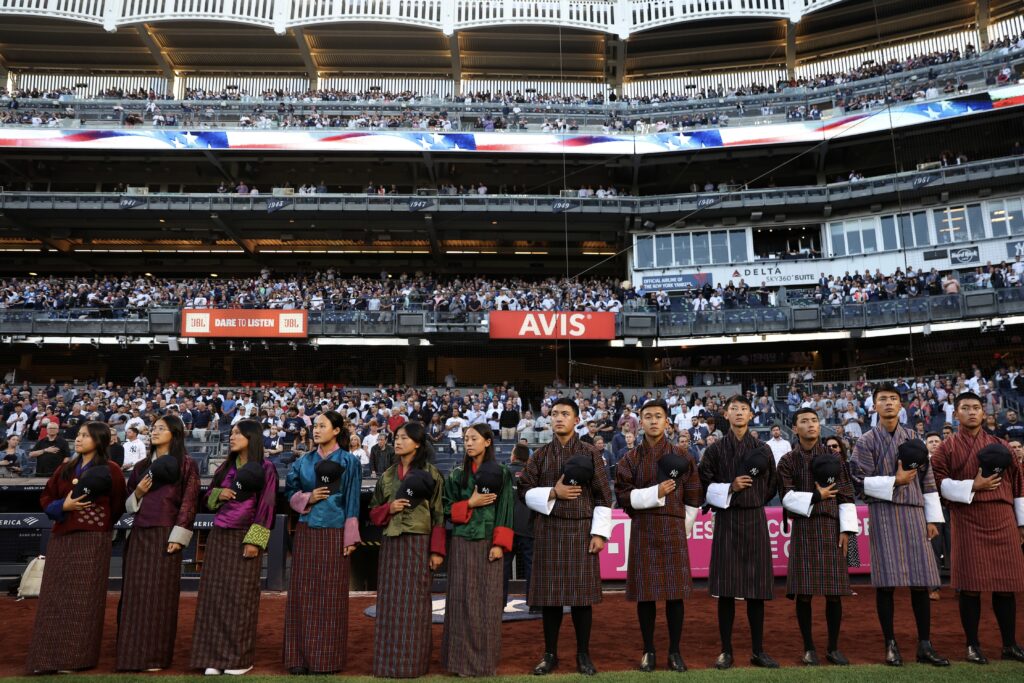
Picture Courtesy : Matthew DeSantis
Are there any stories from young Bhutanese players whose lives changed because of baseball?
For many kids, baseball isn’t just a sport—it’s a new world opening. Take Thinley Jamtsho, 17, who went from practicing on makeshift fields to being the first Bhutanese player selected for the MLB China Summer League in 2025. “Baseball taught me discipline and gave me a dream I never knew I had,” he shares.
And then there’s Tshering Yangdon, just 15, whose biggest takeaway came thousands of miles from home: “Traveling to the USA with the team showed me that anything is possible if we work hard.”
How do parents and communities perceive the sport now compared to when it began?
When baseball first touched Bhutanese soil, it was a stranger—a curious game with unfamiliar rules and foreign equipment. Parents looked on with hesitation, wondering if this sport, so different from anything their children had known, could ever find a home here. For a while, the sound of a ball hitting a glove drew more puzzled glances than cheers.
But change often begins with a few believers. Early adopters—Bhutanese who had seen the game in countries like the USA, Japan, and Korea—carried a quiet conviction that baseball could offer more than just play. They saw discipline in its rhythm, teamwork in its essence, and resilience in every inning. Their faith sparked a movement.
What started as 50 children gathering on weekends, swinging bats on borrowed fields, has now grown into a thriving community of over 3,000 registered players, with 600 active participants in Thimphu alone. Today, parents who once wondered now stand proudly on the sidelines, watching their children grow—not just as athletes, but as disciplined, confident individuals who understand the value of effort, respect, and unity.
Baseball in Bhutan is no longer a question. It is an answer—a new way for youth to dream, learn, and believe in possibilities that stretch far beyond the diamond.
Can you share a personal anecdote from the founders or key leaders?
Karma Dorji, President & Co Founder
My love for baseball began when I engaged in the World Children’s Baseball Fair in Japan, where I experienced the sport’s unique power to unite young people from around the world. That moment sparked a lifelong passion. A year later, I had the privilege of playing in Bhutan’s first ever adult baseball league game in Thimphu with Matthew, an experience that brought that early inspiration full circle. Being on the field as both a player and co-founder of the Bhutan Baseball & Softball Association reminded me how far we’ve come in building a community around the game and how much further we can go in creating opportunities for youth through sport.
Sanjeevan Raj Gurung-General Secretary, a key figure in BBSA’s development, has a rich sporting history. From playing football in his youth to representing Bhutan in cricket for over a decade, his journey took a turn in 2020 when he was introduced to baseball.
“When the pandemic hit, I thought my sporting career was at a crossroads,” Sanjeevan recalls. “But baseball and softball gave me a new purpose. Today, my focus is on building domestic and international partnerships with organizations like BOC, WBSC, BFA, and Softball Asia and other international organizations to secure grants, coaching programs, and infrastructure for Bhutan’s youth. Sports have always been my passion, and now, I’m honored to contribute to baseball, softball and baseball5 growth in Bhutan.”
Has baseball contributed to social change—gender equality, youth development, mental health?
BBSA’s journey has been more than about introducing a new sport; it has become a quiet force for social change. At the forefront of this transformation is a deep commitment to gender equality. When the inaugural U15 league launched in 2021, it carried a bold and intentional rule: every team must include five boys and five girls. This simple yet powerful decision opened doors for equal participation, setting a precedent for inclusion in sports.
The league further amplified its message through the presence of inspiring role models—Bhutan’s first Olympic archer, Karma, renowned yoga teacher Mrs. Yangchen, and the GOKAB team—each highlighting the importance of mental strength and physical well-being alongside athletic performance.
Beyond equality, baseball and softball have nurtured youth development, encouraged school retention, and fostered mental health awareness, creating an environment where young athletes grow not just as players, but as balanced, confident individuals.
What role has baseball played in reaching marginalized or at-risk youth?
At the heart of BBSA’s mission lies a simple but powerful promise: no child should be left behind. To honor this, the association provides free training, equipment, and even transportation, ensuring that opportunity is not determined by circumstance.
In 2023, this commitment came to life when 16 children from Bayta Primary School in remote Phobjikha traveled to Thimphu for a summer camp—many setting foot in the capital for the very first time. For these young players, baseball became more than a sport; it became a gateway to new experiences, confidence, and dreams.
The same spirit shone brightly during the historic 2024 USA tour, where 10 of the 12 players hailed from low-income families living in the Royal Bodyguard camp. Their journey is proof that baseball and softball are breaking barriers, creating a level playing field where talent, effort, and passion—not background—define success.
Have there been measurable academic improvements among participants?
Yes, and that’s by design. BBSA enforces a strict academic rule: U12, U15, and U18 players must maintain at least 55% aggregate to participate. Results speak:
90% of U18 national players qualified for higher grades in 2024.
Three players earned RTC-BOC scholarships, each scoring over 60% in Class 12.
Sports and studies go hand-in-hand here.
What was the toughest moment in the journey?
One of the greatest challenges in this journey has been finding a home for the game. Baseball, by its very nature, demands wide, open spaces—something not easily available in Bhutan’s rugged landscape. In the early days, BBSA depended on school football grounds, working around tight schedules and often facing financial constraints.
“We had to plan programs around school timetables, and at times, some institutions requested fees we simply couldn’t afford,” recalls General Secretary Sanjeevan Raj Gurung.
Today, there is gratitude for the generosity of Dechencholing Higher Secondary School and the Royal Bodyguard, who provide facilities free of charge. Yet, operational costs remain a significant hurdle. Still, BBSA moves forward—anchored by an unshakable belief that baseball and softball do more than teach a game; they instill discipline, resilience, and values that endure far beyond the field.
How do coaches and organizers fight burnout?
What keeps the coaches and organizers going, even through challenges, is the unwavering spirit of Bhutan’s youth. Their passion and commitment breathe life into every training session, every game, every dream. “Seeing players who started with us on day one grow into confident leaders is incredibly rewarding,” shares Tshering Zangmo Sherpa, Head of the Women’s Department and a dedicated coach.
This journey is not walked alone. Parents and schools have become pillars of support, cheering from the sidelines, encouraging their children, and witnessing firsthand how the sport shapes character, discipline, and resilience. Together, they form the heartbeat of a movement that is as much about building futures as it is about playing a game.
What are BBSA’s key goals for the next 3–5 years?
In the coming years, BBSA’s vision is clear and deeply rooted in creating lasting opportunities for Bhutanese youth. One of the top priorities is the establishment of the country’s first dedicated baseball and softball field—a space that young players can truly call their own.
Beyond infrastructure, the association is committed to bringing the sport into more schools, ensuring that every child, regardless of where they live, has a chance to experience the game.
Plans are also underway to formalize structured leagues across western Bhutan, creating a strong foundation for national-level competition and sustained player development.
Finally, BBSA aspires to open more international pathways, giving Bhutanese athletes the opportunity to train, compete, and shine on global platforms—turning dreams into possibilities and possibilities into realities.
What would success look like in 10 years?
Looking ahead, success for BBSA is not measured only in trophies or titles, but in creating a future where opportunity and access are within every child’s reach. In the next decade, the dream is to see Bhutan step proudly onto the international stage, competing with confidence and grace.
Equally significant would be the achievement of a Bhutanese athlete earning a scholarship to play baseball, softball, or Baseball5 abroad—or even signing with a professional or developmental league. These milestones would represent not just personal triumphs, but national progress.
Yet, perhaps the most meaningful measure of success lies closer to home: ensuring that all three disciplines become a permanent part of Bhutanese schools as sanctioned sports—rooted in sustainability, embraced by communities, and celebrated as a tool for education, growth, and unity.
How do rural communities respond to the game?
When baseball first traveled beyond the capital into Bhutan’s remote districts, curiosity mingled with confusion. For many children, the game was unfamiliar—some mistook it for cricket, and the gloves felt awkward on their hands. But that uncertainty didn’t last long. Within a few days of training, hesitation gave way to excitement, and the fields echoed with laughter and determination.
In a delightful twist, many rural youths shared that they had seen baseball before—not on a field, but on screen. Thanks to the popular anime Doraemon, nearly 60% of the children already recognized the game. What began as an unexpected cultural link soon became a bridge, helping these young players embrace a sport that now feels like their own.
What keeps volunteers coming back?
Baseball’s roots in Bhutan trace back to a quiet but determined effort led by Co-Founder and Chairman Matthew DeSantis, who first introduced the game over 15 years ago with the support of the Bhutan Olympic Committee. What began as a simple vision soon grew into a movement, thanks to the trust and encouragement of individuals who believed in its potential.
Among them is Madam Kathleen, a respected Board Member of the Bhutan Cultural Exchange, whose guidance and confidence were instrumental in formalizing the Bhutan Baseball & Softball Association in 2021. Her leadership has provided a strong foundation for the sport’s growth, ensuring it aligns with Bhutan’s values and aspirations.
Equally vital has been the unwavering support of Ramon Riesgo, BBSA’s Head of International Relations. For over a decade, Ramon has worked tirelessly—often from afar—driven by a lifelong passion for baseball and a deep commitment to empowering youth through sport. His dedication to building global partnerships has opened doors to opportunities that once felt out of reach for Bhutanese players.
Together, these efforts reflect not just a love for the game, but a shared belief that baseball can be more than a sport—it can be a tool for learning, growth, and unity in Bhutan.
Are former players now coaching?
Yes. Early stars like Rinzin Dorji and Thinley Choden Choda now coach, mentoring the next generation. Even some U18 players are training U12 and U15 teams—proof the cycle of giving back has begun.
In Bhutan, baseball it’s a journey of patience, unity, and dreams stitched together, much like the 108 sacred seams on the ball we play.
Profiles of key players and coaches?
Thinley Jamtsho (17)
School: Dechencholing HSS, Grade 11 (Arts).
Achievements: First Bhutanese in MLB China Summer League (2025), U18 captain, USA tour 2024.
Tshering Yangdon (15)
School: Dechencholing HSS, Grade 10.
Achievements: Youngest on U18 softball team; flagged by US coaches for college-level potential.
Coach Jigdrel Wangchuk (26)
Former cricketer turned WBSC-certified coach; heads U18 and senior men’s baseball teams.
Most emotional moment?
For Sanjeevan:
“Standing at Yankee Stadium with 12 Bhutanese kids, hearing our anthem alongside the USA’s—that was surreal.”
For Coach Zangmo:
“Watching my first batch of 13-year-olds become national players, and Thinley heading to MLB—it was a dream come true.”
How does baseball fit Bhutanese values?
Baseball has done more than arrive in Bhutan; it has quietly woven itself into the fabric of Bhutanese life. At its core, the sport is a meditation in motion—a game that rewards patience, presence of mind, and an unwavering sense of discipline. These are not foreign concepts here; they are the very virtues Bhutan holds sacred, echoed in the country’s cultural and spiritual traditions.
Unlike sports driven solely by speed or strength, baseball and softball thrive on strategy, awareness, and cooperation. Every pitch, every swing, every stolen base is a lesson in trust—trusting your teammates, respecting your opponents, and believing in something bigger than the self. This collective harmony resonates deeply with Bhutanese values, where community and interconnectedness guide daily life.
And then there is the symbolism—quiet, profound, and almost poetic. A baseball carries 108 stitches, mirroring the sacred number in Buddhism, a number that signifies wholeness, spiritual completeness, and the cyclical nature of life. That a modern sport could carry within it a symbol so steeped in Bhutan’s spiritual tradition feels less like coincidence and more like destiny.
“A baseball has 108 stitches—the same sacred number in Buddhism.”
Bhutan Charts a Fresh Path in Sports Leadership
Curious to know who’s shaping the future of sports in Bhutan? Meet the full executive board here